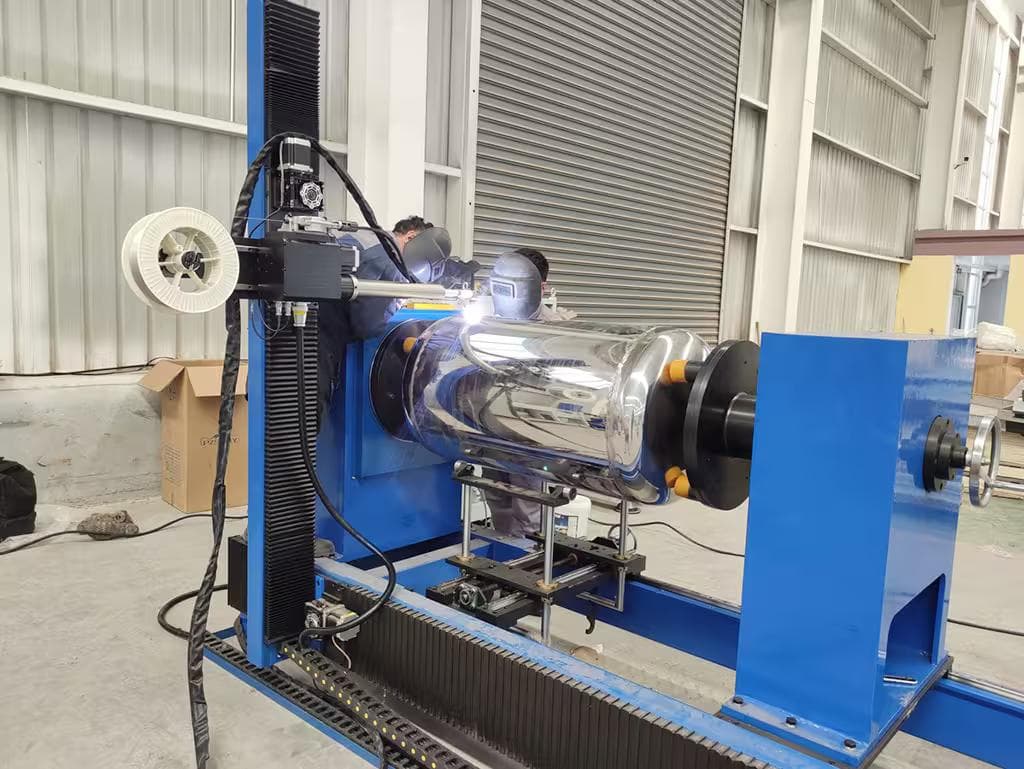
In modern industrial manufacturing, welding large tanks and pressure vessels presents significant challenges for traditional manual labor, particularly regarding consistency, efficiency, and defect rates. This article explores the critical transition from manual to intelligent automatic welding systems in tank production. We break down the inherent difficulties of long-distance circumferential and longitudinal seams and highlight how advanced solutions, like the Jin Luding HZK1220F-TD Automatic Tank Welding Machine, leverage precision TIG welding, intelligent tracking, and automated wire feeding to guarantee flawless, repeatable results. Ultimately, embracing these technologies drives down operational costs and elevates production standards for global manufacturers.
The Critical Demands of Tank and Vessel Welding
Across heavy industries—ranging from oil and gas and hydrogen energy to biopharmaceuticals and lithium battery manufacturing—tanks and pressure vessels are foundational components. These structures are subjected to extreme internal pressures, corrosive environments, and stringent safety regulations.
Because of these extreme operating conditions, the integrity of every weld is non-negotiable. Whether it is a head-to-cylinder circumferential weld or a continuous straight longitudinal seam, the welding process must guarantee complete penetration, zero porosity, and a structurally flawless finish. For decades, manufacturers relied on highly skilled craftsmen to achieve these results. However, as production demands scale globally, relying solely on manual labor is no longer a viable strategy for high-volume, high-stakes industrial manufacturing.
The Bottlenecks of Manual Seam Welding
While human expertise is invaluable for complex, custom fit-ups, manual welding falls short when tasked with the repetitive, large-scale demands of tank and cylinder manufacturing. The primary bottlenecks include:
- Welder Fatigue: Welding a continuous circumferential seam on a large-diameter tank requires maintaining a steady hand and consistent travel speed for extended periods. Human fatigue inevitably leads to micro-fluctuations in the torch angle and arc length.
- Inconsistent Quality: Manual welding is subject to daily variations in human performance. In pressure vessel manufacturing, even a minor inconsistency can lead to a failed Non-Destructive Test (NDT), resulting in costly rework or scrapped materials.
- Inefficiency: Manual welding of thick-walled cylinders often requires multiple passes (root, fill, and cap). Doing this by hand is incredibly time-consuming and heavily restricts the factory's overall throughput.
Elevating Quality with Automatic TIG Systems
To overcome the limitations of manual labor, forward-thinking manufacturers are adopting intelligent welding automation equipment. Automatic TIG (Tungsten Inert Gas) welding systems are specifically engineered to provide the predictability and precision required for tank fabrication.
By automating the core variables of the weld—amperage, voltage, travel speed, and wire feed rate—these machines eliminate the risk of human error. Advanced systems incorporate essential technologies to maintain quality:
- Arc Voltage Control (AVC): Automatically adjusts the torch height in real-time to maintain a perfectly consistent arc length, even if the tank is slightly elliptical.
- Oscillation Systems (OSC): Weaves the torch mechanically to ensure proper sidewall fusion and an aesthetically pleasing weld bead on wider joints.
Product Spotlight: The HZK1220F-TD Automatic Tank Welding Machine
At Jin Luding Welding, we understand the complex geometry and rigorous standards of tank manufacturing. To directly address these industry challenges, we developed the HZK1220F-TD Automatic Tank Welding Machine.
Engineered for precision and versatility, the HZK1220F-TD is designed to handle cylinder head circumferential welds, straight longitudinal seams, and internal/external fillet welds of cylinder flanges all within a single, modular system.
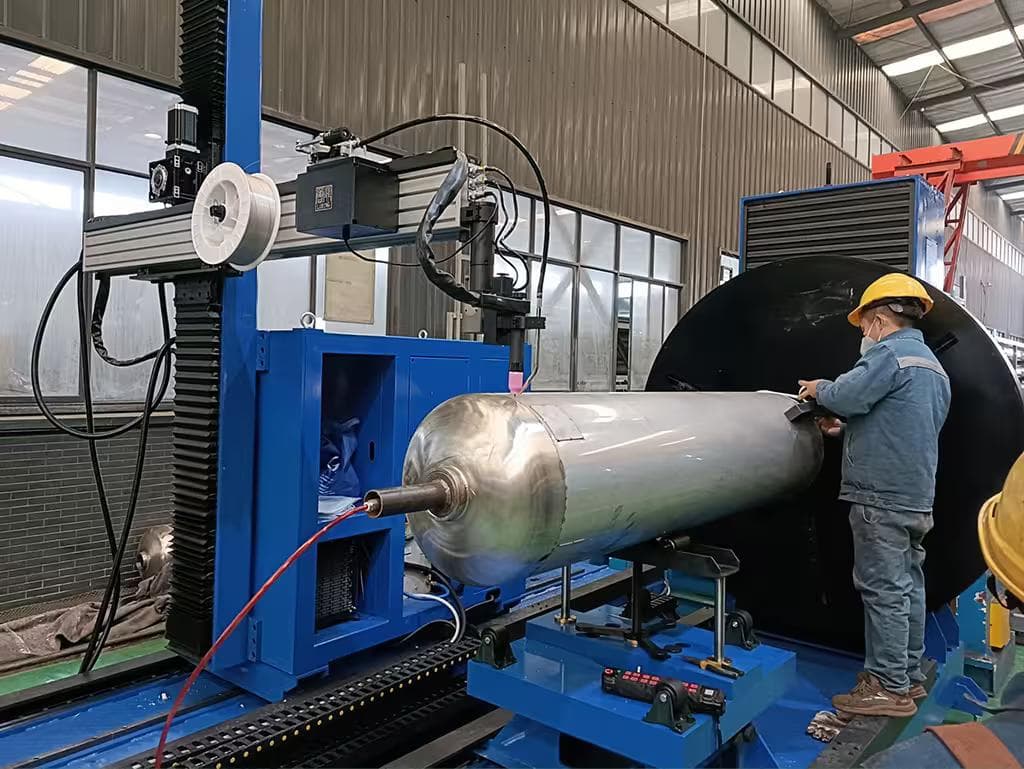
Key Technical Advantages of the HZK1220F-TD:
- Versatile Clamping & Rotation: Features a three-jaw electric self-centering chuck and an electric main shaft box, ensuring rapid loading and perfectly synchronized rotation for workpieces of varying lengths and diameters.
- Intelligent Programming: The color touchscreen controller can store up to 40 distinct welding processes (30 circumferential and 10 longitudinal), allowing operators to instantly recall parameters for different batches.
- Automated Multi-Layer Welding: Capable of executing multi-layer passes autonomously. Combined with a CNC automatic wire feeder featuring pulsed feeding and retraction, it guarantees high-deposition accuracy without operator intervention.
- Industrial-Grade Reliability: Built with a forced circulation water-cooling system and paired with a premium Panasonic YC-400TX TIG power source, the machine is designed for uninterrupted, continuous operation in demanding factory environments.
``
(Explore the full technical specifications of the HZK1220F-TD Automatic Tank Welding Machine here.)
Conclusion: Future-Proofing Your Production Line
The transition from manual to automated tank welding is no longer just a competitive advantage; it is an industrial necessity. By integrating high-precision automatic welding solutions like the HZK1220F-TD, manufacturers can drastically reduce their reliance on scarce manual labor, eliminate costly weld defects, and significantly increase production capacity.
With nearly 20 years of experience in welding automation and a strong foundation in R&D, Jin Luding Welding is committed to providing global B2B markets with reliable, industrial-grade equipment that solves real-world manufacturing challenges.