From all-position gravity challenges to zero-defect pressure standards, discover the real reasons pipe girth weld welding demands the rarest skilled labor — and how intelligent TIG automation is changing the equation.
Introduction: The Most Deceptive Circle in Industrial Manufacturing
To an outsider, a pipe circumferential weld — known in the trade as a girth weld or ring seam — looks like a simple circle of metal fused around a pipe joint. To a qualified welding engineer, that same circle represents one of the most mechanically and operationally demanding seam types in the entire fabrication industry.
Pipe circumferential welds are everywhere. They are the critical joints connecting sections of oil and gas pipelines, thermal district-heating networks, chemical process piping, offshore subsea risers, and high-pressure hydraulic systems. Without reliable girth welds, none of these systems can safely operate. And yet, despite their prevalence and importance, producing a consistently defect-free circumferential seam remains a challenge that separates average shop welders from the narrow tier of certified pipeline specialists.
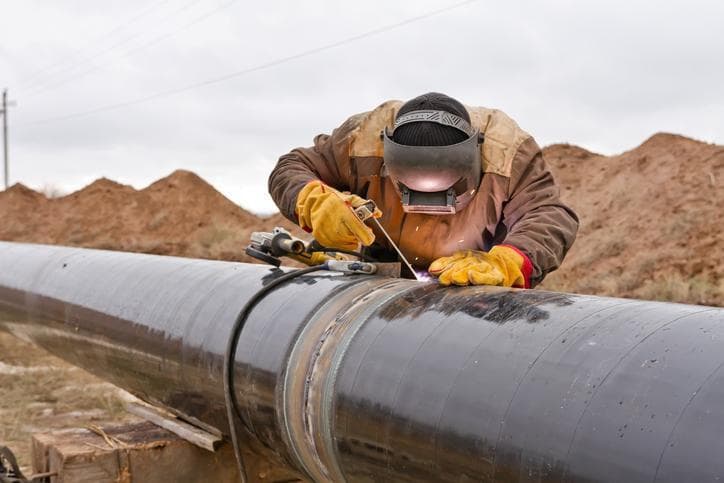
The gap is real. Experienced structural welders who produce flawless flat-plate or fixture welds daily frequently struggle when they rotate to pipe work. Undercut, incomplete penetration, porosity, irregular bead profiles — defects that rarely appear on flat joints — emerge with alarming frequency on pipe girth welds. This is not a reflection of the welder's skill in general; it is a reflection of how uniquely and systematically difficult circumferential pipe welding actually is.
This article breaks down the three root causes behind that difficulty, examines why the problem is worsening as the qualified welder workforce shrinks, and explains how modern intelligent automation is beginning to offer a credible path forward.
The Geometry Problem — Confined Access and a Weld Pool You Cannot Fully See
The first and most fundamental challenge of circumferential pipe welding comes from the geometry of the workpiece itself.
Unlike flat plate welding — where the welder has unobstructed sightlines, freedom of torch movement, and a stable, consistent gravity vector across the entire joint — pipe girth welding places the operator inside a set of geometric constraints that tighten with every reduction in pipe diameter or increase in wall thickness.
The confined space problem is acute in the small-bore, thick-wall, high-pressure pipe categories most common in petrochemical and process plant piping. The curved outer surface of the pipe physically limits how far a torch or wire feeder can swing. On pipes below 50mm outer diameter, it is common for the torch angle to deviate from ideal by 15° or more simply because there is no room to position it correctly. Wire feeding angle is equally restricted, which directly affects consistent filler deposition and the risk of cold lap or fusion defects at the weld toe.
Visibility of the weld pool is the second constraint. Unlike flat welding, where the welder looks directly down into an open pool, the curvature of the pipe — and particularly the pipe wall on the opposite side — obstructs direct sightlines. The welder cannot clearly observe melt width, melt depth, or pool fluidity as the torch moves around the joint. Melt-through on thin-walled pipe and incomplete fusion on thick-walled pipe both trace back to this fundamental visibility deficit; the welder is making real-time parameter decisions without the visual feedback necessary to make them accurately.
Postural fatigue compounds both issues. A circumferential weld on a fixed pipe requires the welder to continuously shift body position — crouching, leaning, lying at awkward angles — to access each clock-position of the joint. Long-duration pipeline construction shifts require this physical repositioning to be repeated across dozens of joints. The accumulated fatigue is directly measurable in quality degradation: defect rates reliably climb across a shift as welder fatigue increases, which is why inspection pass rates are typically lower in the second half of any workday on manual pipe construction proje
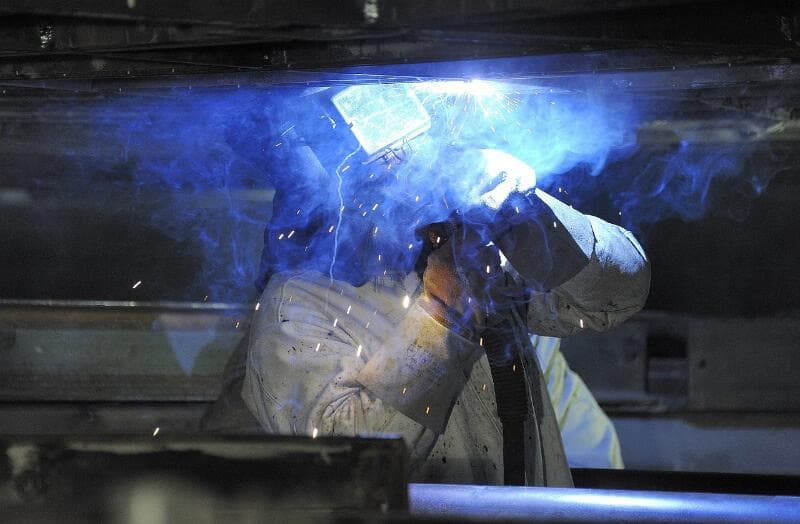
All-Position Welding — Three Joints Hiding Inside One Circle
The second layer of difficulty is thermodynamic and process-mechanical: a single circumferential weld is not one welding condition. It is three fundamentally different welding conditions — flat (1G), vertical (2G/3G), and overhead (4G) — compressed into a continuous seam that must transition between them seamlessly and without stopping.
Each position subjects the molten weld pool to a completely different gravitational load vector:
Flat position (top of pipe, 12 o'clock): The melt pool tends to sag and accumulate under its own weight. The result, if current or travel speed is not reduced at the right moment, is excessive reinforcement height — a weld crown that is too tall and too narrow, which creates stress concentration points in service.
Vertical positions (3 o'clock and 9 o'clock): Gravity acts laterally across the pool. Molten metal wants to flow downward out of the joint, producing uneven bead profiles, undercut on the upper toe, and overlap or cold-lap on the lower toe. Managing this position requires the welder to actively counteract gravity through a combination of arc manipulation and reduced heat input — a physically demanding, cognitively intensive task.
Overhead position (6 o'clock, bottom of pipe): This is universally the most difficult quadrant. Gravity now pulls the entire melt pool away from the joint and toward the floor. Without compensating technique, the pool collapses (sags down into the pipe bore), producing concavity on the weld face or outright burn-through. Getting consistent root penetration in the overhead position without creating internal sagging is one of the most demanding skills in all of welding.
The critical point is that a manual welder must monitor all three of these conditions continuously and make real-time micro-adjustments to current (amperage), travel speed, torch angle, wire feed rate, and oscillation pattern as each clock-position of the joint passes under the arc. There is no pause, no reset. The weld pool does not stop moving while the welder recalculates. This demand for continuous, position-aware parameter management is why circumferential pipe welding skill takes years to develop and why even experienced structural welders find the transition to pipe work unexpectedly steep.
Pressure Pipe Standards — When Every Defect Is a Potential Failure Event
The third dimension of difficulty is regulatory and safety-critical: the acceptance standards for pressure pipeline girth welds are among the strictest in the fabrication industry, and with good reason.
Pressure pipelines carry high-temperature, high-pressure, and often chemically aggressive process fluids across long distances and extended service lives. Unlike structural steel welds — where a small surface discontinuity may be accepted with engineering justification — pipeline girth welds are required to be essentially defect-free through their entire cross-section, because the consequences of in-service failure are severe.
Research from ScienceDirect demonstrates exactly how significant this risk is. Studies of oil and gas pipeline incident records show that over 70% of leakage incidents during pressure testing and initial operation were related to circumferential weld defects. A historical analysis of a major oil pipeline found that out of 30 rupture incidents over a seven-year period, 27 were directly attributable to circumferential weld failure. The U.S. alone recorded ten separate circumferential weld failure incidents between 2010 and 2018 on X70-grade steel pipelines.
The reason defects are so consequential comes down to fracture mechanics. A tiny gas pore or slag inclusion in a finished girth weld — invisible to the eye, perhaps 1–2mm in diameter — is structurally irrelevant in static conditions. But under the cyclic pressure loading that every operating pipeline experiences, that defect becomes a stress concentration point. Each pressure cycle extends the micro-crack. Over weeks, months, or years of service, what began as a microscopic flaw grows into a through-wall crack, then a leak, and potentially a catastrophic rupture.
This is why pressure pipeline girth welds are subject to mandatory non-destructive testing (NDT) protocols, typically including:
- RT (Radiographic Testing): X-ray imaging of the full weld cross-section to detect internal porosity, slag inclusions, and incomplete fusion invisible from the outside.
- UT (Ultrasonic Testing): Phased array or time-of-flight diffraction (TOFD) techniques that can detect crack-like planar defects with sub-millimeter resolution.
- Visual and dimensional inspection of weld profile, reinforcement height, and surface condition.
A weld that fails any of these inspections must be excavated and re-welded — a process that costs significantly more in labor, materials, and downtime than getting it right the first time. This inspection regime, combined with the genuine technical difficulty of achieving a defect-free seam under all-position conditions, is what drives the welder qualification process for pressure pipe work to its demanding standards.
The Labor Crisis Driving the Urgency — Certified Pipeline Welders Are Vanishing
The operational challenges described above have always made certified pipeline welders rare. What has changed in the past decade is the scale of the shortage — and the trajectory is accelerating, not stabilizing.
According to the American Welding Society (AWS), approximately 330,000 new welding professionals will be needed in the United States alone by 2028, with an estimated 82,500 to 90,000 openings per year between 2025 and 2029. Some industry analysts place the deficit figure even higher — at 375,000 to 400,000 workers — when factoring in attrition from retirements across the same period.
The underlying driver is demographic. The average age of a professional welder in the U.S. is currently 55 years old. Approximately 30% of the existing welding workforce was already approaching retirement eligibility as of late 2025. For every five skilled tradespeople leaving the profession, only two are entering to replace them — a replacement ratio that guarantees the gap widens with every passing year.
Canada faces a parallel trend. Welding demand has been assessed as a moderate risk of shortage from 2024 through 2033, driven by infrastructure investment, energy sector expansion, and an aging skilled trades workforce experiencing the same retirement wave.
The shortage is not evenly distributed. It is most acute precisely where the skills are most demanding — in pipe welding specializations, where the all-position qualification requirements, the NDT acceptance standards, and the physical demands of field construction work combine to create the longest and most expensive training pathways. Pipeline welding certificates require hundreds of hours of documented practice, formal qualification tests, and in many jurisdictions, ongoing re-qualification at regular intervals. The result is a category of skilled labor that commands premium wages — and remains critically undersupplied anyway.
For manufacturers and contractors relying on manual circumferential welding, this shortage translates directly into project delays, cost overruns, increased defect rates from undertrained operators, and unsustainable wage pressure on a talent pool that is structurally shrinking.
How Intelligent Automation Changes the Equation
The three challenges described above — geometric constraints, all-position process complexity, and zero-tolerance quality standards — are exactly the problems that intelligent automated welding systems are purpose-engineered to address.
This is a point worth stating precisely: automation does not replace the welding engineer or eliminate the need for process expertise. What it does is remove the variables that are most sensitive to human physical limitation — hand steadiness, postural endurance, real-time parameter intuition under fatigue — and replace them with programmable, repeatable, sensor-controlled machine behavior. The result is a process that is simultaneously more consistent, more auditable, and more accessible to a broader operator base.
The core principle of automated circumferential welding is to keep the workpiece stationary and move the welding system around it in a controlled mechanical orbit, or — for large-bore site pipelines — to fix the welding head on the pipe and rotate the arc mechanically. Either way, the elimination of manual torch manipulation is the foundation of quality improvement.
Research from ESAB confirms this directly. Because automated orbital welding moves the torch continuously and smoothly around the pipe, there is no need for the welder to stop and restart across different clock positions. This eliminates the restart defects — porosity clusters, burn-back craters, and inconsistent penetration — that manual starts and stops consistently introduce. The parameter control system precisely monitors and adjusts arc voltage, current, travel speed, and wire feed across every degree of rotation, maintaining the target heat input regardless of position.
Critically, the automation also addresses the all-position gravity challenge algorithmically. By dividing the pipe circumference into programmable angular segments and assigning different current levels, travel speeds, torch oscillation patterns, and wire feed rates to each segment, the system replicates — and quantifiably surpasses — the real-time parameter judgment that experienced manual welders develop over years of practice. That judgment is no longer in the welder's hands; it is encoded in the program.
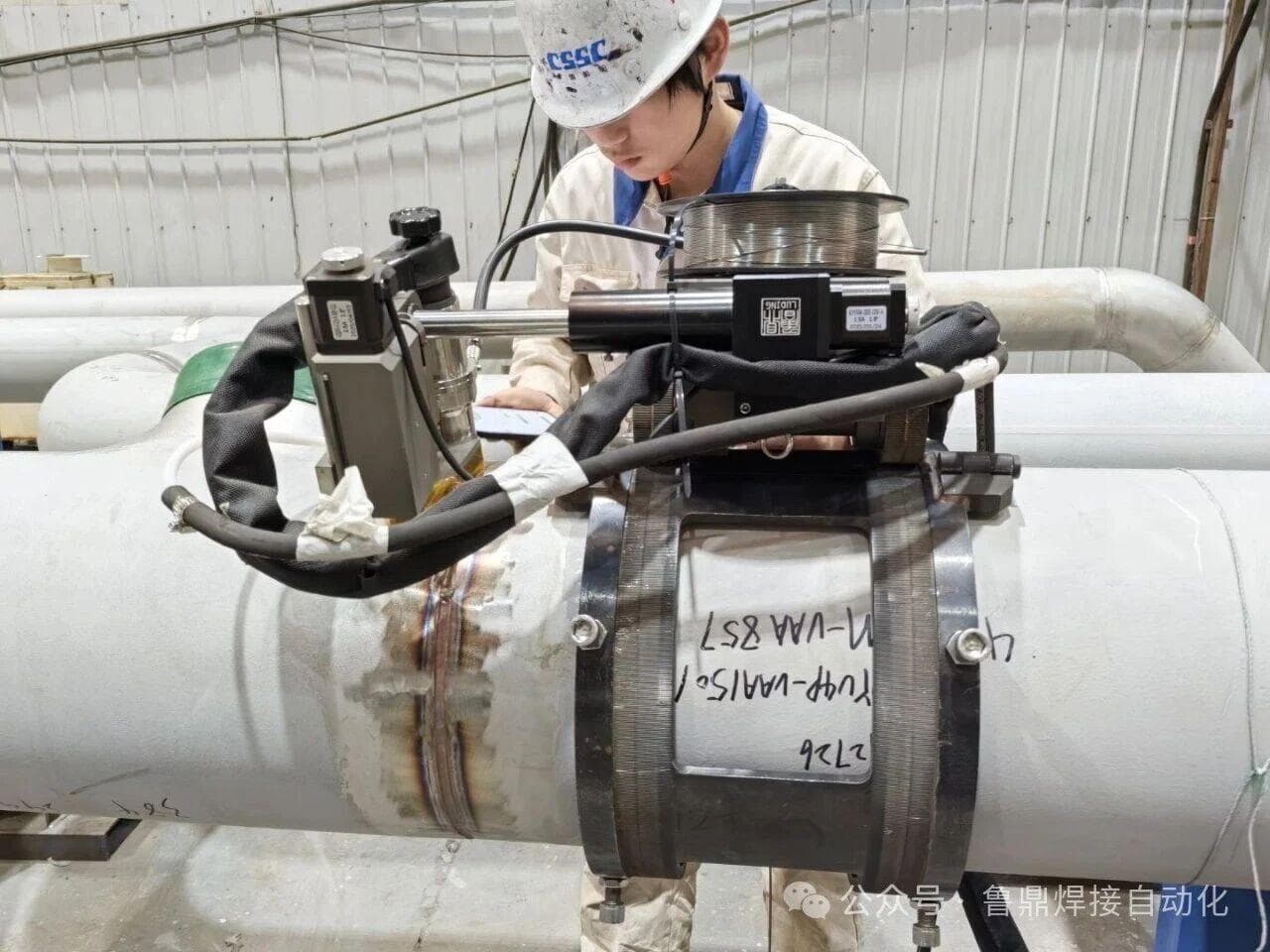
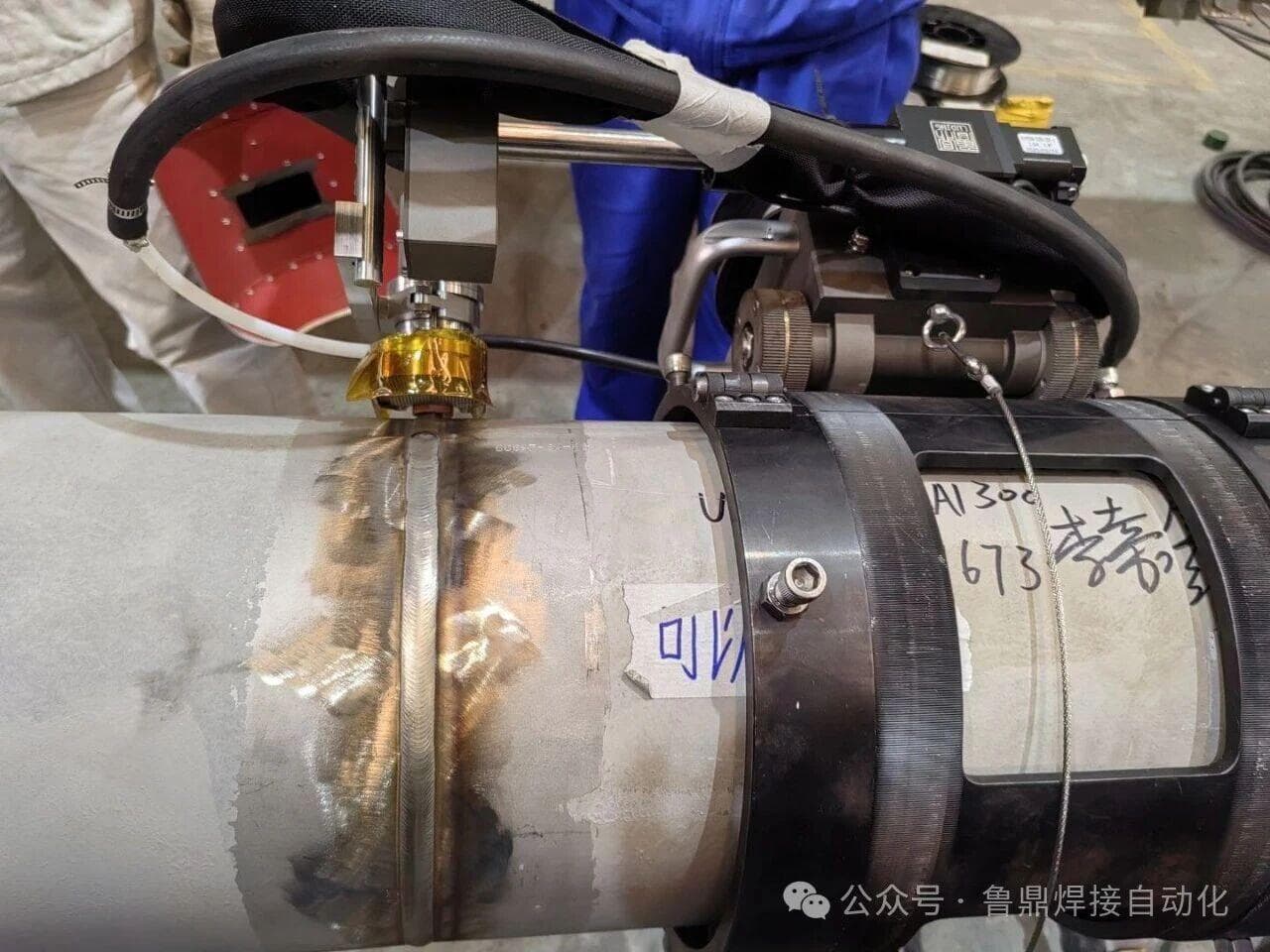
Jin Luding's approach in the APF160-RST Full-Position Pipeline TIG Welding System reflects this engineering philosophy across every major technical decision:
- Magnetic crawler with permanent magnet wheel adsorption allows the welding head to traverse the pipe circumference hands-free, maintaining precise standoff and torch angle even on vertical and overhead sections, without requiring the operator to change physical position or manage torch movement.
- 8-segment interval parameter programming with 30 stored welding procedure programs converts what was once a welder's accumulated experience into a replicable digital process. Root pass, fill pass, and cap pass parameters for specific pipe grades, wall thicknesses, and joint configurations are stored, documented, and repeatable across every shift, every operator, every job.
- Hot wire TIG welding with OSC (oscillation) control enables higher deposition rates than cold wire TIG while maintaining the metallurgical cleanliness that pressure pipe acceptance standards require. The programmed oscillation pattern manages bead width and fusion at the toes without relying on manual weave skill.
- AVC (Arc Voltage Control) automatically adjusts the torch standoff distance in real time to compensate for pipe-surface irregularities, ovality, and joint misalignment — maintaining consistent arc length and heat input even when the workpiece surface is not geometrically ideal.
- Wireless remote control combined with touchscreen interface allows the operator to monitor the weld in real time and intervene if necessary, while the system handles the mechanical precision. The human remains in the loop for quality judgment; the machine handles the physical execution.
The practical outcome of this architecture is a process that consistently produces X-ray-quality girth welds — meeting the RT and UT acceptance criteria of pressure pipe codes — using operators who have received structured training on the system, without requiring the years of manual skill development that equivalent manual certification demands.
Conclusion: Engineering the Controllable, Scaling the Repeatable
Circumferential pipe welding is difficult for reasons that are physical, mechanical, and regulatory — and none of those reasons are going away. The geometry of the pipe, the behavior of molten metal under gravity, and the safety requirements of pressure-rated systems create a convergence of challenges that has always made girth welding one of the industry's most demanding specializations.
What has changed is the context in which that difficulty operates. A global shortage of qualified pipeline welders, an aging professional workforce, and rising project quality demands are combining to make the traditional approach — find the right person, train them for years, hope they stay — increasingly impractical as a production strategy.
Intelligent automated welding systems do not dissolve the difficulty; they re-engineer where it sits. The physical and real-time judgment demands shift from the operator's body and hands to the machine's programmable control architecture. Process expertise — understanding joint design, material compatibility, preheat requirements, and code compliance — remains essential. But that expertise now governs a system that can execute consistently across positions, shifts, and operators in ways that even the most skilled manual welder cannot maintain indefinitely.
For manufacturers in oil and gas, petrochemical processing, shipbuilding, and industrial piping, that shift from variable to repeatable is the foundation of competitive production quality.
Source References
- ScienceDirect — "Predicting the remaining life of oil pipeline circumferential welds based on hybrid machine learning-based methods" (2024) — https://www.sciencedirect.com/science/article/abs/pii/S0360544224023922
- American Welding Society — Welding Workforce Data 2025 — https://weldingworkforcedata.com/
- Welding Online Academy — "The State of Welding: Skill Shortages, Retirements, and Rising Demand" (November 2025) — https://weldingonlineacademy.com/the-state-of-welding/
- ESAB University — "Key Advantages and Disadvantages of Orbital Welding" — https://esab.com/us/nam_en/esab-university/articles/key-advantages-and-disadvantages-of-orbital-welding-ami/
- ESAB University — "Applying Different Welding Techniques to Orbital Welding" — https://esab.com/us/nam_en/esab-university/articles/applying-different-welding-techniques-to-orbital-welding-ami/
- Novarc Technologies — "Addressing the Skilled Trade Shortage: A Focus on Welders" (December 2025) — https://www.novarctech.com/resources/blog/welding/addressing-the-skilled-trade-shortage-a-focus-on-welders/