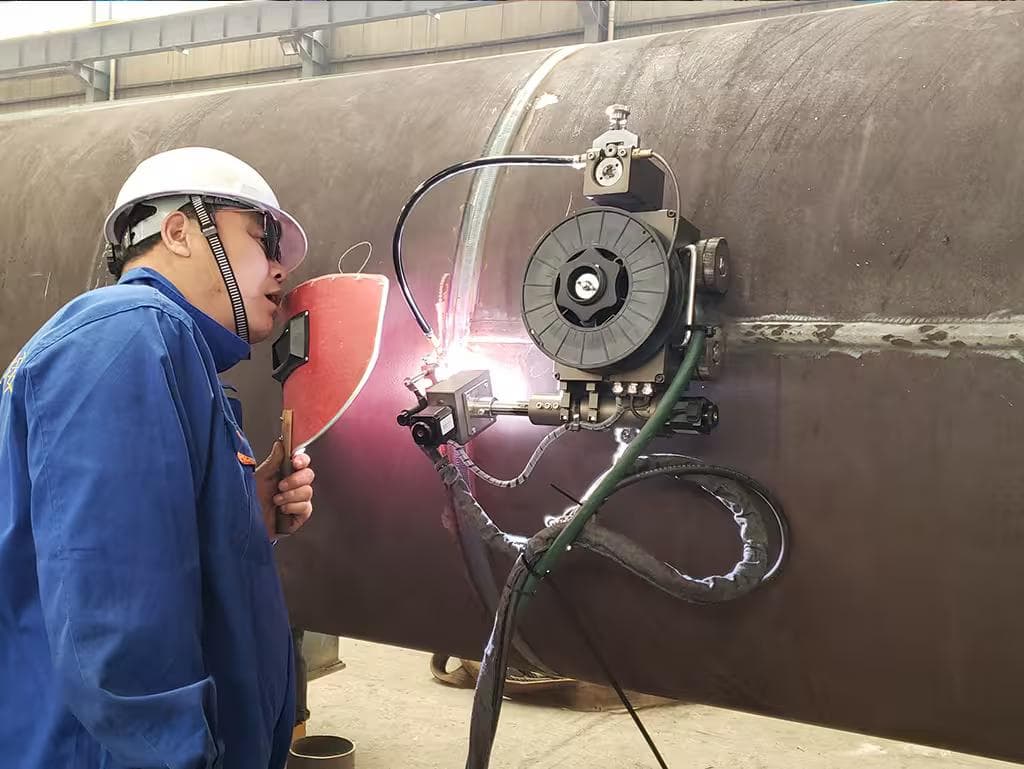
In industrial pipeline construction, executing flawless all-position pipe welds is notoriously difficult due to changing gravity effects on the weld pool. Manual welding requires highly skilled operators, yet remains susceptible to fatigue and inconsistent defect rates. This article explores the critical transition to automated all-position pipe welding. We examine how advanced equipment like the Jin Luding APF-T (APF160-RST) overcomes traditional bottlenecks by utilizing intelligent magnetic crawler systems, multi-segment programmable parameters, and automated Arc Voltage Control (AVC). By adopting these intelligent orbital solutions, manufacturers can drastically reduce reliance on scarce manual labor, ensure X-ray quality seams, and significantly boost on-site productivity.
The Complexities of All-Position Pipe Welding
In heavy industries such as oil and gas, shipbuilding, and chemical processing, pipelines are the critical arteries that sustain operations. These pipelines require pipe-to-pipe circumferential seams that must withstand immense pressure and harsh environmental conditions. The primary challenge in creating these seams is the necessity of "all-position" welding—welding a fixed pipe 360 degrees around its circumference.
As the welding torch moves around the pipe, the influence of gravity on the molten weld pool constantly changes. A welder must seamlessly transition between flat, vertical, and overhead positions, dynamically adjusting their travel speed, torch angle, and heat input to prevent the weld pool from sagging or dripping. Achieving complete penetration and a structurally sound root pass under these variable conditions requires an extraordinary level of metallurgical skill and steady execution.
The Bottlenecks of Manual Pipe Fabrication
While highly skilled manual welders have historically met these challenges, relying solely on human labor for high-volume pipeline construction introduces significant bottlenecks:
- Operator Fatigue: Maintaining precise torch manipulation in awkward, out-of-position angles (especially overhead) is physically exhausting. Fatigue inevitably leads to micro-fluctuations in arc length and travel speed, compromising weld integrity.
- Inconsistent Defect Rates: Manual pipe welding is highly susceptible to human error. Inconsistencies can lead to porosity, lack of fusion, or slag inclusion, resulting in failed Non-Destructive Testing (NDT) and expensive rework.
- The Talent Shortage: The industry is facing a severe shortage of skilled welders capable of executing flawless all-position pipe welds, making it difficult for contractors to scale operations and meet tight project deadlines.
Mastering Consistency with Intelligent Automation
To circumvent the limitations of manual labor, forward-thinking manufacturers are turning to intelligent welding automation. Automated all-position pipe welding systems eliminate the variables introduced by human fatigue, ensuring that the weld pool is perfectly controlled regardless of the torch's position on the pipe.
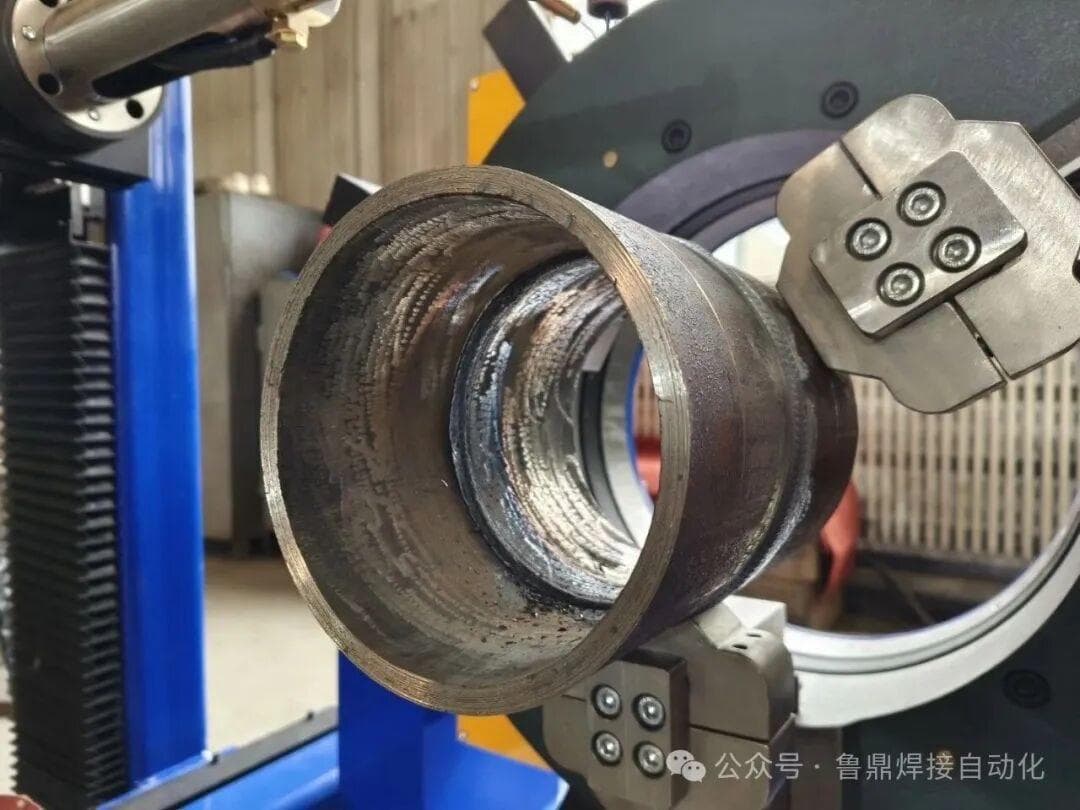
These systems utilize programmable parameters to adjust the welding current, voltage, and wire feed speed dynamically as the machine travels around the pipe's circumference. By mechanically controlling the Arc Voltage Control (AVC) and oscillation width, automated systems guarantee consistent sidewall fusion and an aesthetically perfect cap pass, drastically reducing defect rates and increasing overall throughput.
Product Spotlight: The APF-T (APF160-RST) All-Position Pipe Welding Machine
At Jin Luding Welding, we engineer solutions that directly address the most demanding pipeline construction challenges. The APF-T (APF160-RST) All-Position Pipe Welding Machine is an advanced, automated system designed specifically for pipe-to-pipe circumferential seams.
Key Technical Advantages of the APF-T (APF160-RST):
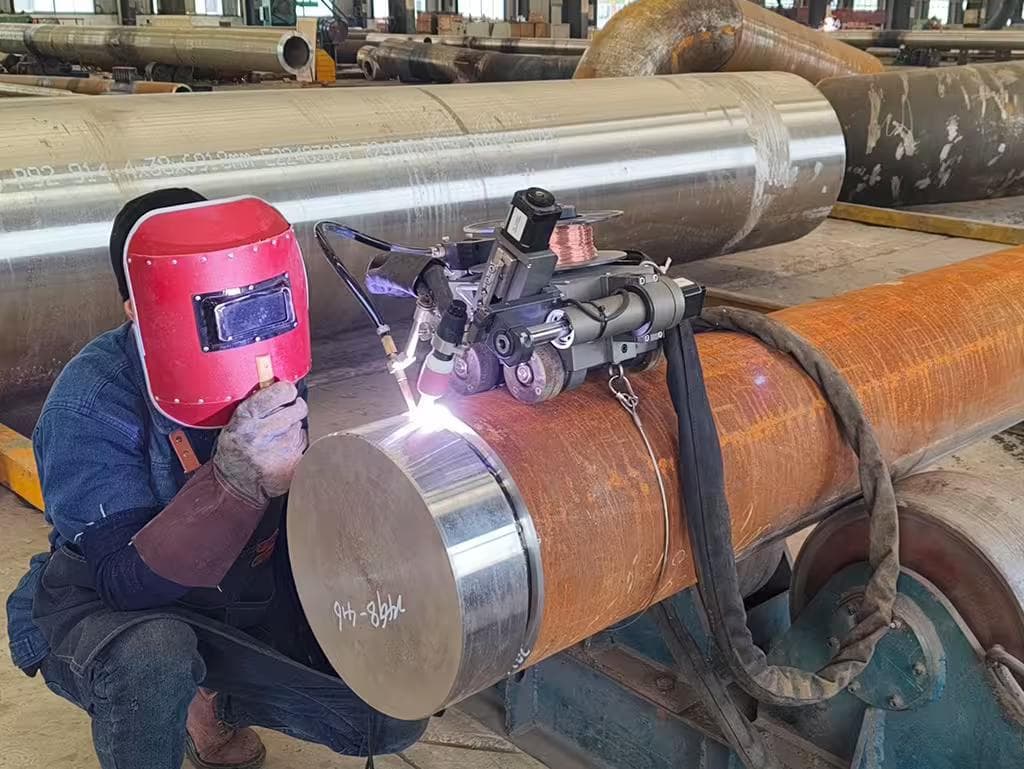
- Versatile Magnetic Crawler System: The machine utilizes a permanent magnetic wheel that adheres directly to the weldment, allowing for smooth rotational movement around the pipe. It is suitable for welding magnetic metals like carbon steel, and can be equipped with an optional special outer orbit to weld non-magnetic metals such as stainless steel.
- Intelligent Segment Programming: To counter the effects of gravity, the system allows up to eight independent welding segment parameters to be programmed in relation to the weldment's circumference. The 7-inch color HMI touchscreen can store up to 30 unique sets of welding procedures for rapid recall.
- Precision Arc & Oscillation Control: Equipped with an Arc Voltage Controller (AVC) and a welding oscillator (OSC), the machine guarantees precise arc lengths and optimal weave patterns. The automatic wire feeder features both impulse wire feeding and automatic wire retraction for flawless root and cap passes.
- Real-Time Wireless Adjustment: Operators are equipped with a wireless handheld remote control, operating at 433MHz, to make real-time, convenient adjustments to parameters like arc length and oscillation amplitude without interrupting the active welding process.
- Industrial Durability: Constructed from high-strength, lightweight aluminum alloy, the unit also features a built-in forced circulation water cooler (18L volume) to ensure reliable, uninterrupted operation for extended periods.
(Explore the full technical capabilities of the APF-T All-Position Pipe Welding Machine here.)
Conclusion: Future-Proofing Pipeline Construction
The shift toward automated all-position pipe welding is an essential evolution for industries that demand structural perfection and high-speed execution. By integrating intelligent equipment like the APF-T (APF160-RST), pipeline contractors can overcome the global welder shortage, eliminate costly rework, and guarantee industrial-grade reliability on every joint.
Backed by nearly 20 years of expertise in welding automation, Jin Luding Welding provides the robust, high-precision equipment required to elevate your fabrication standards and scale your global operations.