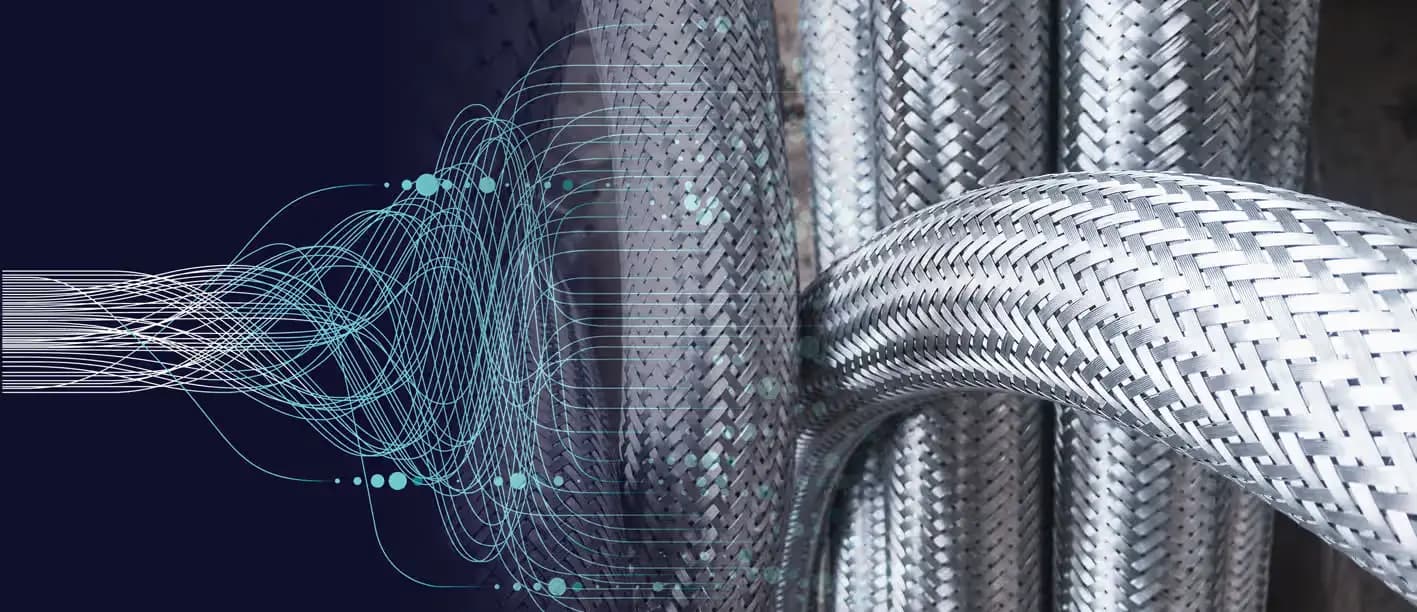
AI cooling demand is straining corrugated metal hose welds. See what causes hose failure and how automatic welding prevents it.
Intro
Corrugated metal hose welding for data centers isn't a niche fabrication task anymore, AI buildouts have turned it into a volume problem. Global Market Insights projects the data center liquid cooling market to grow from $6 billion in 2026 to $27.1 billion by 2035, an 18.2% CAGR, as GPU racks like NVIDIA's GB200 now call for roughly 140 kW of liquid cooling versus a 7–10 kW air-cooled baseline. Every one of those loops runs on corrugated metal hose.
More hose through fabrication shops means more welds, and more welds means less room for the failure modes the industry already knows well — heat-affected zone corrosion, fatigue cracking, pressure rupture. This post covers why that demand is putting new pressure on corrugated hose, what actually causes it to fail, and why the weld joint, not just the alloy, usually decides whether an assembly survives.
Why AI Data Center Cooling Is Driving a Corrugated Hose Boom
Rigid pipe can't absorb what an AI data hall throws at it, the thermal expansion, building settlement, and pump vibration between chillers, pumps, and rack manifolds all transfer straight into a rigid joint as stress. Corrugated and braided stainless hose absorbs that movement instead, which is why it shows up in liquid cooling loops, direct-to-chip connections, and secondary cooling circuits.
The construction is tuned for the job: annular hose, such as corrugations stacked parallel rather than wound helically, bends between corrugations instead of through them, giving it longer cycling life in the tight, repeated-bend routing a cooling distribution unit demands. Thinner strip, tighter pitch, and taller corrugations are the main levers for adding flexibility.
Material matters as much as geometry. Data center coolant is often glycol-based, and glycol that overheats or degrades turns acidic, austenitic stainless steel resists that chemistry far longer than the rubber hose it's replacing, which has a shelf life and can blister and outgas under pressure. None of that resistance matters, though, if the weld holding the assembly together is the weak point, which is exactly where hose failures tend to start.
What Actually Fails in a Corrugated Metal Hose
Manufacturers have catalogued corrugated hose failure modes for decades, and AI-scale duty cycles just raise the cost of ignoring them. Corrosion alone takes several forms — uniform, localized pitting, and intergranular, which depletes chromium at the grain boundaries once stainless steel holds at 1,000–1,562°F for extended periods. Stabilized grades like 321, or low-carbon 304L and 316L, resist that mode better than standard alloys.
Fatigue is the most common failure mode of all, and it starts small: flexing, pulsation, torsion, and vibration concentrate stress at non-metallic inclusions already in the metal, and cycling grows that flaw into a circumferential crack at the top or bottom of a corrugation. High flow velocity and off-resonance vibration accelerate the same process, producing spiderweb cracking once a hose vibrates at its own natural frequency too long.
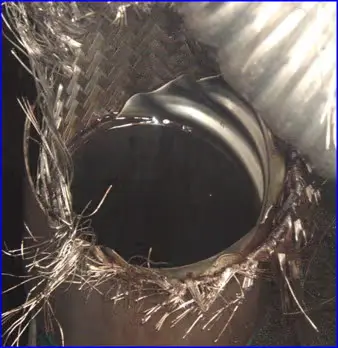
Pressure rupture is the least forgiving mode: once pulsating pressure exceeds the design limit, the braid fails, the inner hose is forced outward, and a tear opens fast, with little warning.
The Weld Is Where Most Failures Actually Start
A pattern runs through that list: several of the worst modes point straight at the weld. The bottom of the corrugation and the weld heat-affected zone are the two spots most prone to corrosion attack — exactly where the welding arc touches. Fatigue cracking starts at non-metallic inclusions and other imperfections in the metal, the kind of defect an inconsistent arc length or uneven travel speed leaves behind.
Argon-purge welding matters here: a consistently purged weld pool avoids the oxidation that weakens parent material and leaves a joint more vulnerable to chemical attack. Skip that purge, or let arc length drift between passes, and the same heat-affected zone becomes the first place a hose fails — no matter how well the rest of the assembly was specified.
None of this mattered much when hose volume was modest and a skilled welder could hand-finish every joint. At AI-driven volumes, a mostly-consistent weld isn't good enough — one leaking joint in a live cooling loop means an unplanned shutdown, not a warranty callback.
Jin Luding's BW70-T: Built for Repeatable Corrugated Hose Welds
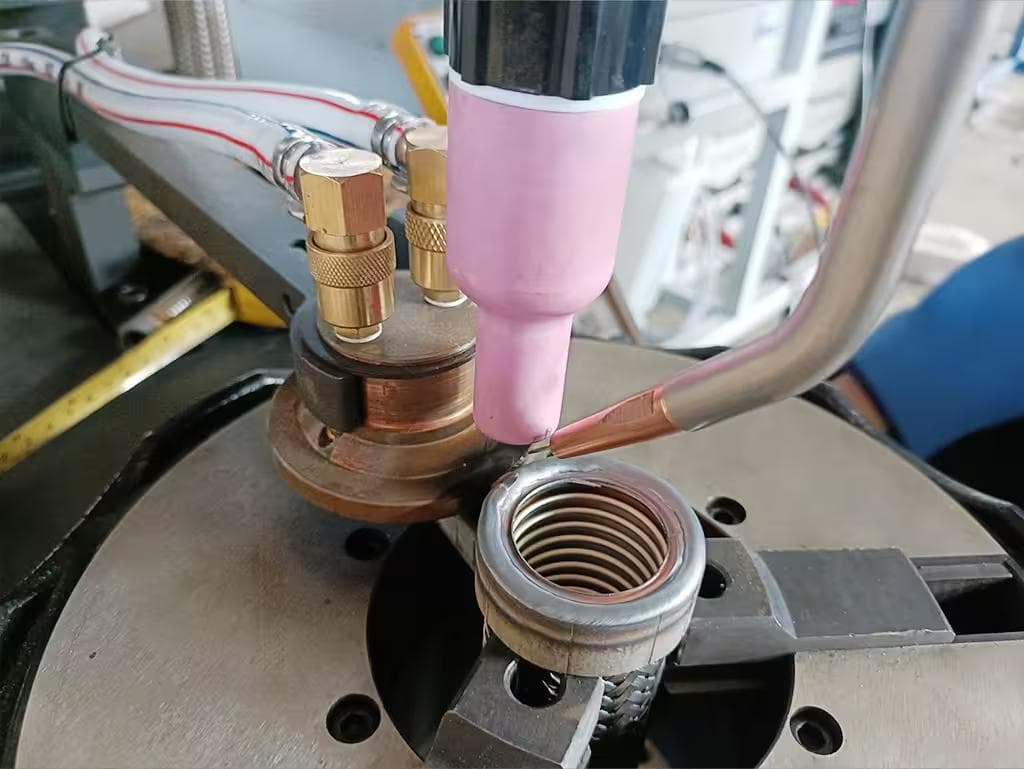
The BW70-T is purpose-built for exactly the joint described above — corrugated hose, mesh braid, and compression collar. A rotating chuck turns the workpiece past a fixed torch for automatic TIG welding, while dual-axis AVC seam tracking holds the arc within ±0.2 mm of the seam, horizontally and vertically, across a 0–20 mm range — keeping the torch centered even when a hose isn't perfectly round, the exact drift that creates the weak point described earlier.
Wire feed follows the same logic: 1.0 mm wire with automatic retraction and impulse feeding is built for defect-free arc starts, cutting the porosity and inclusions that seed fatigue cracks. A water-cooled LD400 TIG torch and forced water cooling keep those parameters stable across long runs, which matters when it's order volume, not one-off jobs, driving demand. A 30-slot recipe memory lets a shop switch between the diameters a CDU line, secondary loop, and rack manifold each need without re-tuning by hand, and it welds carbon steel, low-alloy steel, and stainless steel, covering the austenitic grades data centers specify for glycol compatibility.
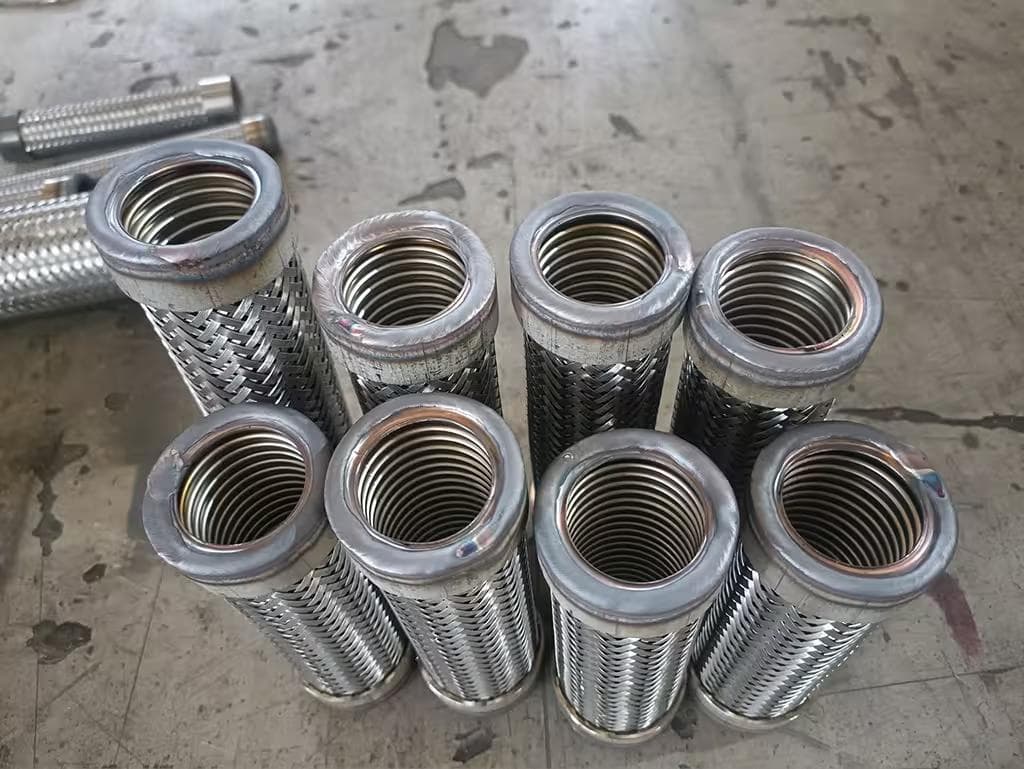
The weld only holds if what comes before it is right: Jin Luding pairs the BW70-T with the BJ70 end-forming machine, which swages annular hose ends from Φ35–80 mm OD using interchangeable molds for uniform prep, and the KY100 crimping machine, which requires a minimum 1 mm collar thickness to eliminate the gaps that cause blow-through — no matter how well the welder is tuned.
FAQ
What hose sizes can be automatically welded for data center cooling assemblies?
The BW70-T handles hose diameters from 18 mm to 70 mm, and the BJ70 end-forming machine preps annular hose ends from Φ35–80 mm OD beforehand, covering most CDU, secondary-loop, and rack-manifold connections.
Does automatic welding remove the need for a skilled welder?
No — it shifts what the operator does. Instead of manually tracking the seam, the welder sets up fixturing, programs the recipe on the HMI, and verifies the finished joint, judgment applied before and after the arc runs instead of during it.
Talk to Jin Luding's engineering team about sizing a line
Why does the crimping step before welding matter this much?
Per the KY100's spec, a collar thinner than 1 mm can't hold a gap-free fit, and any gap between the hose, braid, and collar is a documented cause of blow-through once the torch starts.
Conclusion
AI-driven cooling demand isn't just moving more corrugated metal hose through fabrication shops — it's raising the cost of any single bad weld. The failure modes that take hoses down — heat-affected zone corrosion, fatigue cracks at inclusions, pressure rupture at the braid — trace back to two things: what the hose is made of, and how consistently it was welded and prepped. Material selection is a known problem with known answers. Weld consistency at production volume is the newer one, and it's the one automatic, AVC-controlled TIG welding was built to solve.